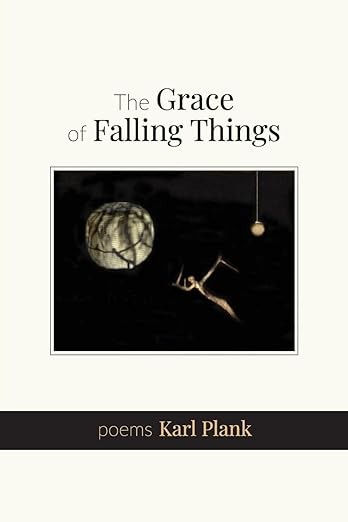
The Grace of Falling Things (Grayson Books, 2024)
(Available from graysonbooks.com, independent book stores, and Amazon)
Karl Plank, of course, is not the first poet to look closely at our fragile, mortal lives, but in contrast to a writer like John Milton, whose focus is “all our woe,” Plank is a generous, compassionate observer of what he sums up in the title of his new collection: The Grace of Falling Things. Throughout these poems, which have an ambitious range of subjects and styles, Plank reminds us that we are called “to witness the downfall,” though he never abandons us to despair. Even though we understand that the carefully detailed moments he describes “will not last,” his poems insist on “art’s possibility.” As in a particularly moving poem on Edward Hopper, Plank tells us that we live “After Eden,” but we also come to understand that poems, like prayers, can have the power to “bring back the lost.” Like a funeral urn carved of spalted maple, these poems honor what is missing and “serve to hold/what remains.” We can only be grateful for these wise words of witness, change, and praise.
Margaret Mackinnon, author of Afternoon in Cartago and The Invented Child
“Advertising,” Thomas Merton noted in Conjectures of a Guilty Bystander, “treats all products with the reverence and the seriousness due to sacraments.” Fortunately, The Grace of Falling Things—which includes elegies, prayers and ekphrastic poems—treats only the truly sacramental with such reverence and seriousness. Karl Plank reminds us that in fact each day of our lives constitutes a threshold to be crossed with the help of grace. For him, sacramental symbols include carpenter’s tools, worn sink basins, the windows of rooms where children sleep, gravestones, tarblooders securing railroad ties with scalding tar, the glow of sun on a man’s bare head, a tin cup full of cool water, a clothesline that looks like a sail. I would venture to say, too, that if reading itself qualifies as a ritual, then reading these poems in particular can help us to negotiate what we find on the other side of each threshold. As Plank argues at the end of his fugue-like sequence “Sentences”:
‘That the earth cracks open, in portals to hidden sanctuaries, to reveal what is deep and beneath and beyond
What is emerging.'”
–Ann Neelon, author of Easter Vigil
BOSS: Rewriting Rilke. A chapbook of micro-monologues that take off from passages of Rilke’s Book of Hours, but veer in their own mysterious direction. Available from Red Bird Chapbooks (https://www.redbirdchapbooks.com/content/boss; and, https://www.redbirdchapbooks.com/content/karl-plank)
“Here, at last, is reflection. And Rilke. And something found, something not quite on the page. It deserves to be read and considered without the intrusion of someone else’s— a reviewer’s— thoughts. Steep in this one. Let it steep in you. A gathering of words this reviewer predicts you will return to again and again and again, anew. ” –Stephanie Olson
A Field, Part Arable. A chapbook of poems is now available for order from Lithic Press (http://www.lithicpress.com/).
 Karl Plank